
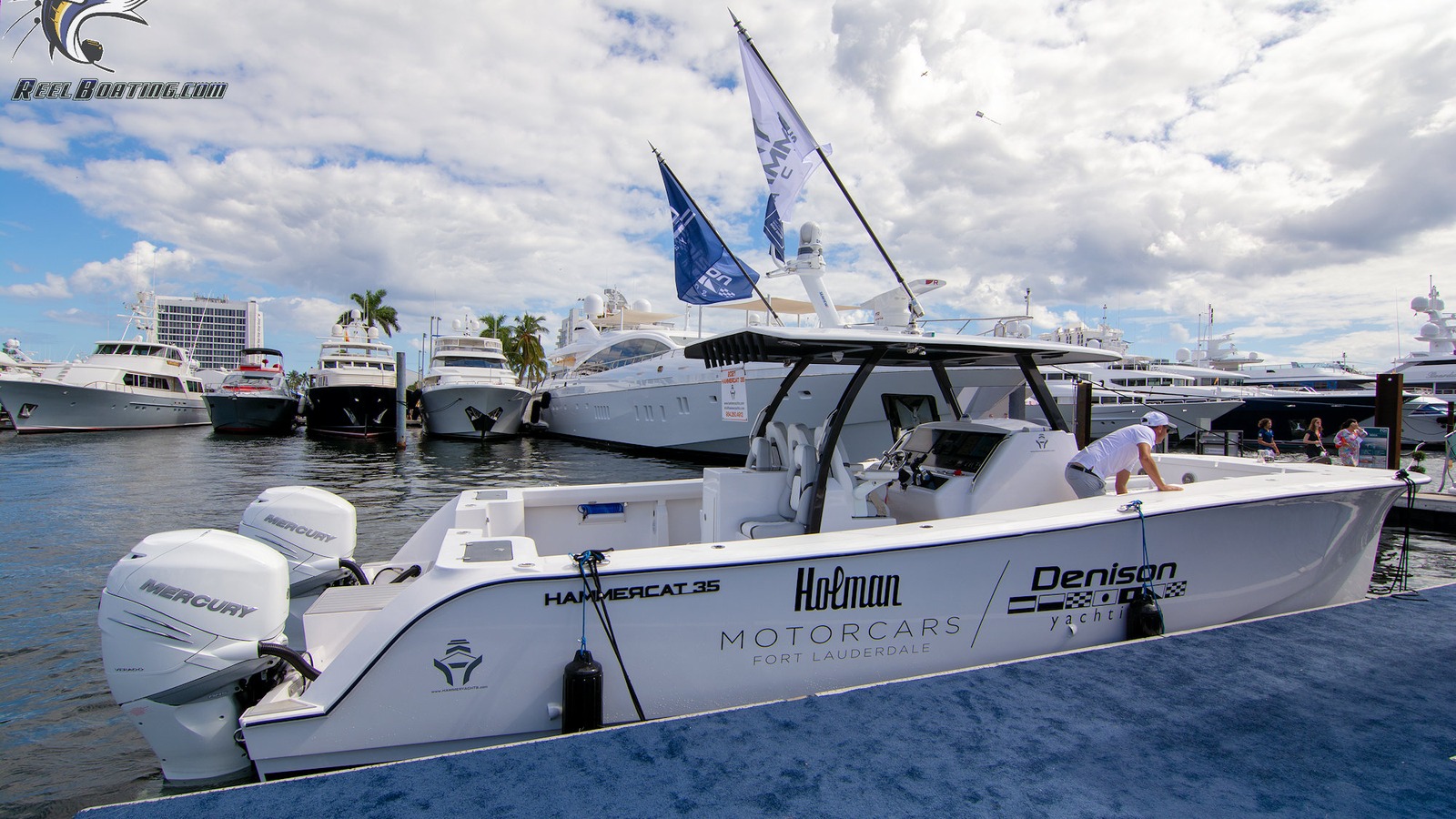
One of our ReelBoating adventures at the 2021 Fort Lauderdale International Boat Show was a sea trial aboard the HammerCat 35. At the helm was Peter Wiersema, founding partner at Hammer Yachts & Brokerage. The HammerCat 35 was the first model built by Hammer Yachts.
Before heading out through Port Everglades, Peter used the boat to shuttle 15 show attendees to an off-site drop-off location. It was a friendly gesture on a day when road traffic around the show was especially heavy. It also provided an immediate demonstration of the usable deck space. Even with that many people aboard, everyone had room to settle in comfortably.
Twin Mercury 350s and a lightweight design
Throttling out through Port Everglades, the twin Mercury 350s delivered plenty of thrust. A boat of this size might appear to need more power, but the HammerCat's hull design and lightweight carbon-fiber hardtop helped make 700 total horsepower feel more than adequate during our run.
Seas off Fort Lauderdale were around two feet that day, so this was not a heavy-weather torture test. We did cross several larger boat wakes, and the HammerCat handled them well.
A noticeably dry ride
One detail stood out immediately: the ride stayed remarkably dry. That mattered because I had a full load of camera equipment aboard. Even while leaning over the gunwales to take photographs, I did not feel more than a trace of sea spray.
Peter was knowledgeable about boat design and willing to walk through the HammerCat from bow to stern. The following specifications and performance statements were provided by Peter Wiersema and Hammer Yachts.
Peter Wiersema on the HammerCat 35
Hammer Yachts designed the HammerCat 35 as a modern center-console power catamaran that can be configured as a sportfishing boat, family boat, dive boat or superyacht tender.
According to Peter, the goal was not to build another conventional center-console sportfishing boat. The company focused instead on experienced boaters who might fish one day, dive the next and still want enough room to bring family and friends.
Construction, weight and efficiency
Hammer Yachts says the HammerCat 35 is built with epoxy and vacuum-infused E-glass. The company lists a wet weight of approximately 8,500 pounds, compared with some similarly sized power catamarans that can weigh as much as 14,000 pounds and use four engines.
The lighter construction allows the HammerCat to use less horsepower while still delivering competitive performance. Hammer Yachts says this also improves fuel economy, range, agility and ride quality.
Range and performance
With twin 350-horsepower engines and 400 gallons of fuel, Hammer Yachts claims a range of more than 600 miles at speeds above 25 mph. The company also says the boat can plane on one 350-horsepower engine, providing a useful margin if an engine problem occurs offshore.
Hammer Yachts lists a top speed of more than 50 mph with twin 350s, with larger engine options available for additional top-end speed.
Flotation and offshore design
Hammer Yachts describes the HammerCat 35 as unsinkable, citing 43 cubic feet of XPS foam intended to keep the boat afloat after a serious collision with a submerged object.
The hardtop measures approximately 10 by 12 feet and weighs about 150 pounds. Keeping that weight low helps reduce the influence of the top on the boat's behavior in offshore conditions. Its generous size also provides substantial shade and weather protection for the crew.
The company says the boat uses construction techniques more commonly seen in offshore racing yachts. Epoxy resin offers greater flexural strength and elongation than the polyester or vinylester resins used in many production boats, allowing the structure to be strong without carrying unnecessary weight.
Final impressions
The HammerCat 35 combines a distinctive power-catamaran hull with the layout and versatility expected from a modern center console. Its Carolina-style bow, flared hull and clean curves give it a more traditional profile than many power cats.
Our time aboard was limited, and the light conditions did not reveal how the boat would behave in a serious offshore sea. What the trial did show was strong acceleration, useful space, a dry ride and a design that deserved a closer look.
Written by Wiley for ReelBoating.com