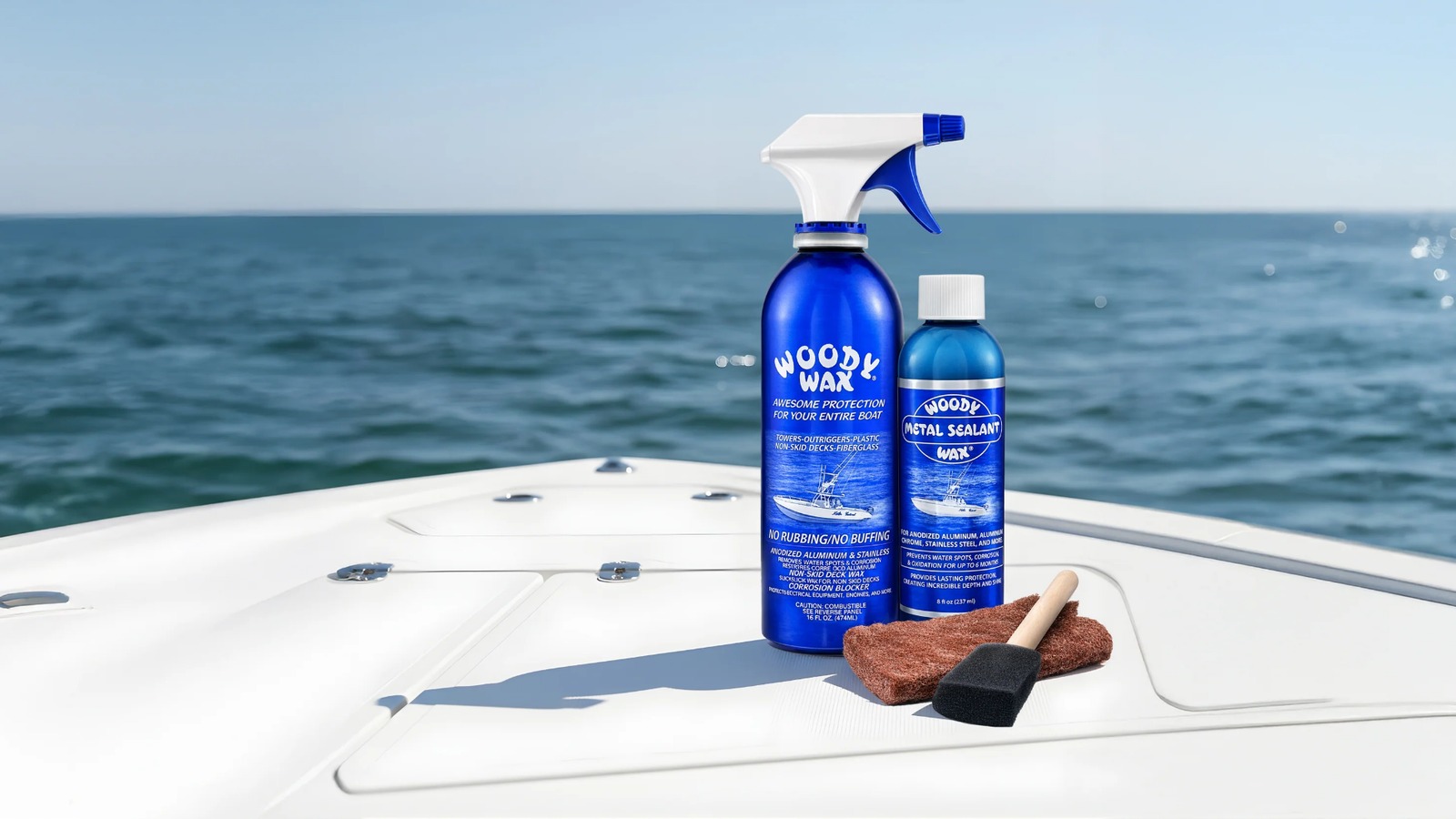
Is it time to wax your boat? The harder question is deciding which product
belongs on which surface.
The ReelBoating relationship with Woody Wax goes back many years. Woody Wax
was one of my earliest marine-industry advertisers, dating back to The Hull
Truth days, and I have watched the product line develop into one of the most
recognized names in boat care.
But popularity does not automatically make one product the best choice for
every boat. Woody Wax, Collinite, Meguiar's, RejeX, Star brite, PTFE-based
products and 3M all approach protection and shine a little differently.
Woody Wax is not always an apples-to-apples comparison
Woody Wax is often discussed alongside conventional boat waxes, but many
boaters use it primarily on non-skid decks, metal, hardware and other marine
surfaces. That makes it different from a traditional paste or liquid wax
applied mainly to smooth gelcoat.
One issue that followed Woody Wax around boating forums was confusion about
the application process. The company now provides surface-specific
instructions, including guidance for fiberglass and non-skid decks.
View the official Woody Wax application instructions
Popular boat wax and protection alternatives
The following products and product categories are commonly discussed by
boat owners. The links are placeholders for future affiliate resources and
buying options.
-
Woody Wax
— Best known for multi-surface marine protection, including non-skid
decks and metal. Application technique matters.
-
Collinite
— Frequently praised for durable protection and a strong finish, though
some owners prefer a more involved preparation and application process.
-
Meguiar's
— Offers a broad marine product line and is often chosen by boaters who
want a straightforward liquid application on fiberglass.
-
RejeX
— A polymer-style protective finish commonly associated with high gloss,
slickness and easier cleanup.
-
Star brite
— A marine-specific product family with different waxes, polishes and
restoration products for varying levels of oxidation.
-
PTFE-based wax and sealant products
— A broad category of slick protective coatings. Check the label for
marine-surface compatibility before use.
-
3M Marine
— A longstanding choice for compounds, polishes and waxes, especially
when gelcoat needs correction before final protection.
What matters more than the brand name
The best product depends on the condition of the surface and the result you
want. A lightly oxidized hull, a heavily weathered gelcoat surface, polished
metal and a non-skid deck do not necessarily need the same treatment.
Before choosing a product, consider:
- The surface being treated
- The amount of oxidation or staining
- Whether correction is needed before protection
- The labor and application time involved
- The finish, durability and maintenance schedule you expect
Woody Wax vs. the competition
There is no shortage of strong opinions about the best boat wax. Woody Wax
remains a useful option, particularly when its intended surfaces and
application method match the job. Collinite, Meguiar's, RejeX, Star brite,
PTFE-based products and 3M each deserve consideration for different reasons.
This article will be expanded as ReelBoating adds updated hands-on product
comparisons, application notes and related forum discussions.
Written by Wiley for ReelBoating.com
ReelBoating Community
What ReelBoating members are saying
Looking to get a buffer to wax my boat. Need your help!!
These comments are pulled directly from the live ReelBoating discussion.
Member names and post wording come from the forum conversation.
50 replies
24,654 views

I had posted this on the hull truth and got some good suggestions. I would like to hear from you guys. I own a 2003 21 Bluewater sport fishing boat. I wash her after every use and wax around three times a year. As of late, the gel coat appears to have some slight oxidation. Not so bad that it would chalk up a finger. It just that the finish appears a little hazy. I have researched to death the different types of buffer/polishers. I am a little afraid of the Makita circular buffer and frankly I don't think that I need something that powerful. That leaves me with the random orbital machines. I am looking at the Porter Cable 7424 or the more expensive German made Flex 3401. I will be purchasing a selection of Lake Country pads and see what works best.
What experience have you had with either or both machines? I like the price and size of the Porter Cable but some say that it is a good polisher and don't expect anything more from it. If I need a little more bite will the Porter Cable with a good light compound and a more aggressive pad do the trick or do I bite the bullet and get the Flex?
Regards,
Cabana Dan
Naples, Fl.
View this post in the forum
The detailers at my marina use the Makita circular buffers when they do my boat and it comes out beautiful every time. I once asked a friend that owns an autobody shop the same question about what to buy, and his advise to me was to have the detailers do it, because if you apply too much pressure you'll damage the gelcoat. He also told me that I would probably be sore for a week from using it. 
View this post in the forum
I had posted this on the hull truth and got some good suggestions. I would like to hear from you guys. I own a 2003 21 Bluewater sport fishing boat. I wash her after every use and wax around three times a year. As of late, the gel coat appears to have some slight oxidation. Not so bad that it would chalk up a finger. It just that the finish appears a little hazy. I have researched to death the different types of buffer/polishers. I am a little afraid of the Makita circular buffer and frankly I don't think that I need something that powerful. That leaves me with the random orbital machines. I am looking at the Porter Cable 7424 or the more expensive German made Flex 3401. I will be purchasing a selection of Lake Country pads and see what works best.
What experience have you had with either or both machines? I like the price and size of the Porter Cable but some say that it is a good polisher and don't expect anything more from it. If I need a little more bite will the Porter Cable with a good light compound and a more aggressive pad do the trick or do I bite the bullet and get the Flex?
Regards,
Cabana Dan
Naples, Fl.
Sheila got me the 7424 last year. Good buffer, nice solid construction, works well on the boat. A little on the heavy side but that's the flip side of the solid build quality. I like that the side handle is removable or reversible and the adjustable speed. Both options come in handy at times.
View this post in the forum
Having watched the pros's use a high speed buffer over the years I would strongly recommend an orbital. You will get the shine you want without burning the gel. It only takes one slip with a high speed buffer or tilting it the wrong way and you have problems. If you tilt the buffer it will scratch the gel coat with the center section.
View this post in the forum
You want a random orbital buffer. The orbitals can leave marks.
I have had the Porter Cable for a couple of years and like it a lot. It has done all I have asked without a problem.
View this post in the forum
I use a 6" random orbital el'cheapo from Wally World.
It works great on vehicles and boats.
Really depends on what you are doing with it.
I use it to apply the wax and then remove by hand.
View this post in the forum
This is a live ReelBoating discussion. Read every reply or add your own experience in the forum.
Read All 50 Replies & Join the Discussion